
Lodovico GUICCIARDINI

1521 - 1589

Lodovico Guicciardini was born on August 19, 1521, in Florence, Italy, and died on March 22, 1589, in Antwerp, Belgium. He was born into a prominent patrician Florentine family involved in commerce and scholarship, the son of Iacopo di Piero Guicciardini and Camilla d'Agnolo Bardi. Guicciardini received a rigorous classical humanist education, learning Latin and Greek, before moving to Antwerp in 1541 to manage his family’s mercantile interests. While he did not come from a cartographic background, he was the nephew of the famous Renaissance historian and diplomat Francesco Guicciardini, inheriting a strong lineage of intellectual inquiry that informed his later research and writing.

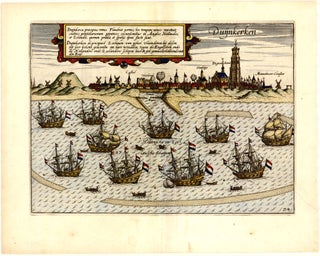
Guicciardini played a foundational role in the development of regional cartography and chorography through his compilation and publication of urban topography. His monumental contribution, Descrittione di tutti i Paesi Bassi (Description of the Low Countries), first published in Antwerp by Willem Silvius in 1567, is widely recognised as the first comprehensive city atlas and geopolitical survey of the region. Rather than drafting the maps himself, Guicciardini acted as an author-compiler, collaborating with leading regional engravers to illustrate his detailed texts on the history, economy, and arts of the Netherlands. The printing and plate production transitioned over successive editions; initial versions relied heavily on woodcuts, but when the master printer Christophe Plantin assumed production from 1580 onward, the publication was upgraded to use fine copperplate engravings. These plates and maps expanded into numerous translations, including French, German, and English, establishing a baseline documentation for European urban iconography.

Lodovico Guicciardini will be remembered for pioneering the integrated regional city atlas, combining rigorous socioeconomic description with precise copperplate cartography to preserve the spatial layout of the Renaissance Low Countries.