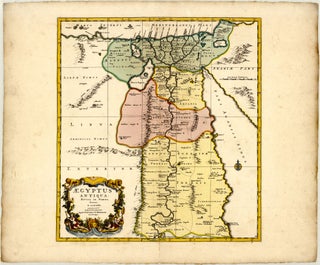
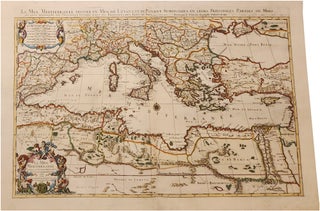
Nicolas SANSON
1600 - 1667
Nicolas Sanson was born in Abbeville, Picardy, France, on December 20 or 31, 1600, and died in Paris on July 7, 1667. He was raised in an old Picard family of Scottish descent and received his education from the Jesuits at Amiens. Sanson pioneered a significant multi-generational cartographic dynasty, securing prestigious French royal appointments that extended across three generations. His work was subsequently carried on by his younger sons, Guillaume (died 1703) and Adrien (died 1708), who both succeeded him in the role of royal geographers. The family business and extensive geographic inventory were later acquired by his grandson, Pierre Moulart-Sanson, maintaining the family’s prominence in map publishing until 1730.
Sanson is widely recognised as the founder of the French school of cartography, an exceptional role that systematically shifted the centre of European mapmaking dominance from the Netherlands to France. He introduced a groundbreaking approach that prioritised clarity, precision, and scientific detail over the lavish, ornate decorative customs of the Dutch Baroque style. Appointed as “Geographe Ordinaire du Roi”, Sanson provided geography lessons to both Louis XIII and Louis XIV, gaining critical royal patronage that financed his production of approximately 300 maps. Throughout his career, he collaborated with prominent publishers and engravers, including Melchior Tavernier, print publisher Pierre Mariette, and later Alexis-Hubert Jaillot, who posthumously compiled Sanson’s maps into the Atlas nouveau in 1692. His milestone publications include his first major map, Postes de France (1632), his influential depiction of North America, Amerique Septentrionale (1650), and his definitive 100-map general world atlas, Cartes Generales de Toutes les Parties du Monde (1654).
He will be remembered as the father of French cartography, who redefined mapmaking by replacing artistic embellishment with geographic accuracy and scientific rigor.