
Johann SCHÖNSPERGER

Johann Schönsperger (also known as Hans Schönsperger the Elder) was born in the 1460s (often cited as circa 1455) in Augsburg, Germany, and died there on February 25, 1521. Not much is known about his family background and education. Schönsperger established a family printing business, with his son, Johann Schönsperger the Younger, training under him and becoming an active printer and publisher in Augsburg and Zwickau.

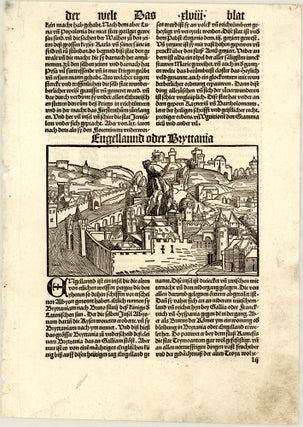
Schönsperger’s significance to cartography and publishing lies in his role as a pioneer of commercial, mass-market regional printing and his later appointment as the imperial court printer to Maximilian I, Holy Roman Emperor. He is widely recognised for publishing successful, downsized “pirate” editions of Hartmann Schedel’s Nuremberg Chronicle (Liber cronicarum) in 1496, 1497, and 1500. By reducing the physical size of the paper and shrinking the woodcut illustrations and maps to roughly a quarter of their original size, he introduced substantial cost-cutting measures that made these historically significant geographical works affordable to the middle class. Beyond these popular volume reproductions, Schönsperger achieved a massive milestone in typographic history by collaborating with punch-cutter Hieronymus Andreae to develop the Fraktur typeface. This highly stylised Gothic script became the standard printing type across the German-speaking world for the subsequent four centuries. His most prominent publications include the reduced editions of the Schedel Weltchronik, the Gart der Gesundheit (1487), a magnificent imperial Prayer Book (Gebetbuch, 1513) printed on vellum, and the Emperor’s epic poem, Theuerdank (1517).

Johann Schönsperger will be remembered as a resourceful publisher who democratised illustrated geographic literature for the public and as a master typographer who anchored the architectural aesthetic of German printing via the creation of the Fraktur typeface.