Vincenzo Maria CORONELLI

1650 - 1718

Vincenzo Maria Coronelli was born on August 16, 1650, in Venice, Italy, and died there on December 9, 1718. He was the fifth child of Maffio Coronelli, a Venetian tailor. At the age of 10, Coronelli moved to Ravenna and began his vocational training as an apprentice to a woodcut printer and xylographer. In 1663, he entered the Conventual Franciscans as a novice, and by 1674, he earned a doctorate in theology from the College of Saint Bonaventure in Rome. During his academic pursuits, he demonstrated significant aptitude in astronomy and Euclidean mathematics, which laid the foundational expertise for his later cartographic endeavors.

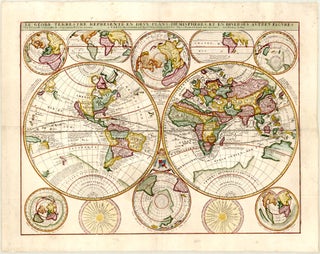
Coronelli is widely recognised as one of the most prominent cartographers and globe makers of the Baroque era, famous for combining meticulous geographic accuracy with dramatic artistic aesthetics. His exceptional achievements include the production of a pair of massive (each, 4 m in diameter and over 2 t in weight) terrestrial and celestial globes constructed in Paris between 1681 and 1683 for King Louis XIV of France. In 1684, he was appointed Cosmographer of the Republic of Venice. In the same year, he founded the Accademia Cosmografica degli Argonauti, which is recognised as the world's first geographical society. Coronelli collaborated closely with French engraver and publisher Jean-Baptiste Nolin to distribute his masterworks. His major printed legacy includes the monumental Atlante Veneto (1691), which served as an extensive multi-volume continuation of the Dutch cartographic tradition, the Libro dei Globi (1697), and the Isolario (1696).

A pioneer in large-scale globe production and collaborative geographic research, Coronelli bridged the worlds of theology, scientific astronomy, and commercial map publishing to define the heights of Late Baroque cartography.