Gerard MERCATOR
1512 - 1594
Gerardus (Gerard) Mercator (the Elder) was born on March 5, 1512, in Rupelmonde, County of Flanders (modern-day Belgium), and died on December 2, 1594, in Duisburg, United Duchies of Jülich-Cleves-Berg (modern-day Germany). Coming from a modest family of an artisan shoemaker, he was educated at the University of Leuven, where he graduated with a Master of Arts degree in 1532. Following his formal studies, Mercator received private training in mathematics, astronomy, and geography from the prominent philosopher Gemma Frisius, and learned the technical skills of engraving and instrument making from the goldsmith Gaspar van der Heyden. Mercator went on to become a groundbreaking cartographer and founder of a highly successful but tragically short-lived cartographic dynasty, with his sons, Arnold, Bartholomeus, and Rumold, and grandsons, Johann, Gerard the Younger, and Michael, all contributing in various capacities to the family business.
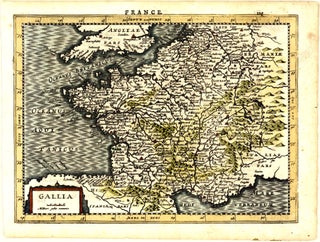
Mercator revolutionised cartography by transitioning the field from a descriptive art into a mathematically rigorous science. His defining breakthrough occurred in 1569 with the introduction of his monumental 18-sheet world map, which debuted the “Mercator projection” – a cylindrical mathematical projection where lines of constant true bearing (rhumb lines) appear as straight lines, solving a critical navigation challenge for mariners. Beyond this calculation mechanism, Mercator pioneered the widespread adoption of clear, elegant Italic lettering on copperplates to replace crowded Gothic scripts, heavily improving map readability. He was also the very first person to apply the term “Atlas” to a bound collection of structural maps, a project he worked on independently but left unfinished. Following his death, his son Rumold – having outlived most of the rest of the family – published the final parts of this definitive collection in 1595. After that, the original copper plates were acquired by publisher Jodocus Hondius I in 1604, ensuring the expansion of the Mercator-Hondius atlases throughout the 17th century.
Gerard Mercator permanently transformed global navigation and cartographic publishing through his mathematical precision, the invention of his enduring map projection, and the structural creation of the modern world atlas.