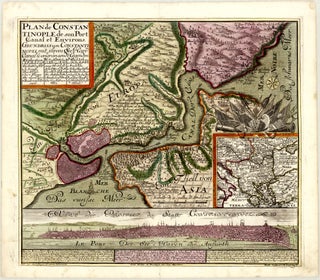
Matthäus SEUTTER
1678 - 1757
Matthäus Seutter was born on September 20, 1678, in Augsburg, Germany, and died there March 11, 1757. He came from a family of goldsmiths and initially trained as a brewer before pivoting to the graphic arts, securing an apprenticeship in Nuremberg under Johann Baptist Homann, the leading German cartographer of the era. By 1707, Seutter had returned to Augsburg to establish his own independent publishing house, which he ran alongside his son, Albrecht Carl, and his son-in-law, Conrad Tobias Lotter.
Seutter played a critical role in shifting the centre of the European map trade from the Netherlands to southern Germany by mass-producing affordable, heavily stylised commercial maps. While his geographical data relied heavily on the prior work of Homann and French cartographers rather than original scientific surveys, Seutter distinguished himself through high-artistry engraving, thick paper stock, and bold, distinctive hand-colouring. His commercial success and dedication earned him the title of Imperial Geographer from Charles VI, Holy Roman Emperor, in 1732. His monumental publication achievements include the Atlas Novus (first issued around 1720) and the Grosser Atlas (circa 1734), which featured detailed town plans alongside regional maps. Following his death, his surviving family continued operations until Conrad Tobias Lotter fully acquired the plates and stock, sustaining the business under the Lotter name.
Matthäus Seutter will be remembered as a commercial titan of 18th-century German cartography who democratised map ownership through high-volume publishing and opulent, baroque visual artistry.