John SPEED

John Speed was born in Farndon, Cheshire, England, in 1551 or 1552, and died in London on July 28, 1629. Not much is known about his formal education. However, he followed his father, John Speed Senior, into the tailoring trade and became a freeman of the Merchant Taylors’ Company in 1580. Speed’s entry into scholarship and cartography occurred later in life, enabled by the patronage of Sir Fulke Greville, who granted him an allowance that allowed him to abandon tailoring and focus exclusively on historical and geographical research.

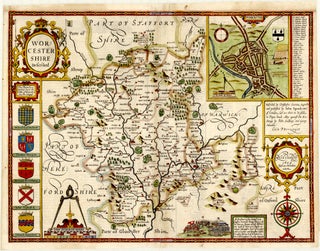
Speed’s role in publishing and cartography was that of a masterful compiler, innovator, and designer. His milestone achievement is The Theatre of the Empire of Great Britaine (1611 or 1612), which stands as the first comprehensive atlas of Great Britain. Speed’s primary cartographic innovation was the systematic introduction of detailed town inset plans directly onto county maps, providing the earliest surviving visual records for many English and Welsh towns. Artistically, his works were defined by high decorative value, utilising Dutch engravers – most notably Jodocus Hondius – to execute highly detailed borders featuring local costumes, historical figures, and heraldic crests. His maps relied heavily on the existing scientific surveys of Christopher Saxton and John Norden, whose plates and data he adapted. In 1627, Speed published Prospect of the Most Famous Parts of the World, universally acknowledged as the first world atlas produced by an Englishman. Following his death, his printing plates and stock were acquired by publishers William Humble, and later, Roger Rea, before being utilised by Thomas Bassett and Richard Chiswell for subsequent editions.

John Speed fundamentally transformed British cartography by combining rigorous historical compilation with innovative visual design, establishing the definitive aesthetic and structural standard for the 17th-century regional atlas.