
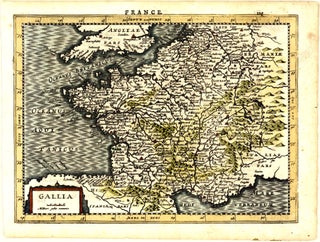
Pieter VAN DEN KEERE

Pieter van den Keere, frequently known by his Latinised name Petrus Kaerius, was born in Ghent in 1571, and died in or shortly after 1646, likely in Amsterdam. His father was the engraver and type founder Hendrik van den Keere. Due to religious persecution, his family fled the Spanish Netherlands around 1583-1584 and resettled in London. Following his sister Colette’s marriage to the prominent cartographer Jodocus Hondius (the Elder) in 1587, Van den Keere was introduced into a highly cooperative network of mapmakers. He received his foundational training as an engraver directly under Hondius, who – beyond being his brother-in-law – had also become his professional mentor. In 1593, Van den Keere and Hondius returned across the channel to settle permanently in Amsterdam.

Van den Keere operated as a highly prolific copperplate engraver, publisher, and globe maker, becoming a critical cog in the Dutch cartographic golden age through extensive collaborations with figures like Willem Blaeu, Petrus Bertius, and Johannes Janssonius. His role was defined by precision craftsmanship rather than theoretical innovation, translating geographic drafts into highly detailed, elegant prints. In 1617, he reached a major milestone by publishing Germania Inferior, which stands as the first original folio-sized regional atlas dedicated entirely to the Seventeen Provinces of the Netherlands. Additionally, around 1599, he completed an extensive series of small-format county maps of the British Isles. Though delayed in publication for nearly two decades, these specific plates were later acquired by the London publisher George Humble. Combined with text adapted from John Speed’s larger folio volumes, they were published in 1627 as a highly successful pocket atlas popularly known as the “Miniature Speeds”. Facing financial hardships and shifting market demands later in life, Van den Keere gradually sold off a significant portion of his printing stock and original atlas plates, most notably to the publisher Claes Janszoon Visscher in 1623.

Pieter van den Keere will be remembered as an exceptional engraver whose skilled hand executed some of the era’s most vital geographic works, effectively bridging the English and Dutch publishing traditions through a deeply connected family network of map production.