Johan NIEUHOF

1618 - 1672

Johan Nieuhof was born on July 22, 1618, in Uelsen, a town in the County of Bentheim, Lower Saxony, near the Dutch border. He died on October 8, 1672, on the island of Madagascar, where he went missing and was presumed murdered after traveling inland to trade. His father was a town mayor, a position later held by one of his brothers. Nieuhof’s path to geographical contribution arose through his career as a globetrotting official and reserve officer-candidate for the Dutch West India Company (WIC) and the Dutch East India Company (VOC).

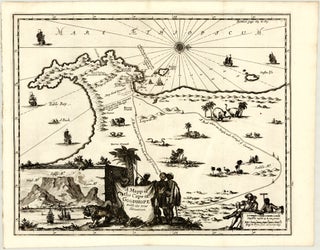
Nieuhof’s primary input to cartography and publishing lies in his firsthand visual and textual documentation of regions largely unknown to 17th-century Europeans. Working as a purser for the VOC embassy to Peking (now Beijing) from 1655 to 1657, he was explicitly instructed to sketch and record the towns, rivers, and palaces he encountered. Upon returning, he entrusted his extensive field drawings and notes to his brother, Hendrik Nieuhof, who collaborated with the prominent Amsterdam publisher and engraver Jacob van Meurs to transform these raw visual logs into refined copper engravings and maps. Though the resulting publications sometimes blended direct observations with stylised European baroque conventions, they served as groundbreaking visual authorities on Asian topography. His seminal work, Het Gezantschap der Neêrlandtsche Oost-Indische Compagnie aan den Grooten Tartarischen Cham (1665), alongside his posthumously published Zee- en Lant-Reise door verscheide Gewesten van Oostindien (1682), provided some of the earliest authoritative maps and cityscape views of China and Southern India, dramatically influencing European geography and sparking the global trend of Chinoiserie.

Johan Nieuhof will be remembered as a pioneering traveller and draftsman, whose vivid firsthand records bridged the gap between Western cartography and the unfamiliar landscapes of the Far East.