
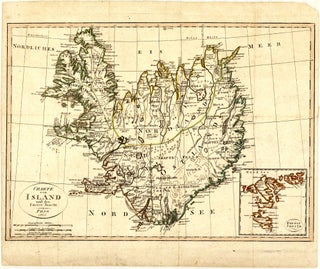
Johann Christoph Matthias REINECKE

Johann Christoph Matthias Reinecke was born in Halberstadt, Germany, in either 1768 or 1769, and died in Coburg on October 7, 1818. He was a multi-disciplinary German scientist who worked as a cartographer, geographer, and palaeontologist. Not much is known about his family background and education.

Reinecke achieved historical recognition primarily as the official cartographer to the Geographisches Institut (Geographical Institute) in Weimar, an organisation that produced prominent German world atlases during the 19th century. His cartographic approach relied on combining modern travel accounts and astronomical observations to create precise regional and continental layouts. He utilised fine engraving techniques, such as hachuring to indicate mountainous terrain and stipple shading for deserts, and his works frequently omitted unexplored interiors in favour of scientific accuracy over speculative geography. His key works include the Charte von Lænder am Caucasus (1804), Charte von Island und den Färöer Inseln (1807), and significant regional sheets for larger collaborative world atlases, including detailed maps of Africa, Scandinavia, and Australia published around 1812.

Reinecke is remembered as a meticulous, scientifically minded polymath who brought precise astronomical and geographical observations to the early 19th-century German atlas publishing industry.